A great man is one who collects knowledge the way a bee collects honey and uses it to help people overcome the difficulties they endure - hunger, ignorance and disease!
- Nikola Tesla

Remember, remember always, that all of us, and you and I especially, are descended from immigrants and revolutionists.
- Franklin Roosevelt

While their territory has been devastated and their homes despoiled, the spirit of the Serbian people has not been broken.
- Woodrow Wilson

Film Screening of "Enclave" followed by Q&A with Director Goran Radovanović

Please join the Njegos Endowment for Serbian Language and Culture at Columbia University's East Central European Center and the Harriman Institute for a screening of the film Enclave (2015) followed by a Q&A with director Goran Radovanović.

Synopsis: A Christian boy, determined to create a proper community burial for his late grandfather, crosses enemy lines and makes friends among the Muslim majority in deeply divided, war-torn Kosovo. Focused on a tiny Serb community living in a UN-protected enclave in Muslim Kosovo, Enclavelooks at the legacy of ethnic cleansing and internecine conflict through the eyes of a small boy, Nenad. Every day Nenad is taken to school from his father’s farm in a KFOR armored car to study alone in a school with no other pupils. Like any other boy of his age, all Nenad wants are some friends his own age. Each day, through narrow observation slits in the military vehicle he sees two Albanian boys and a shepherd boy – who has lost his father in the war and hates Serbs.

The film won an audience award last June after a competition screening at the Moscow International Film Festival, and is Serbia’s nomination for best foreign-language Oscar.
(Source: HollywoodReporter)

For more information and to view a trailer, visit the film’s website here.

Director Goran Radovanović is writer and director of both feature and documentary films. Born in Belgrade in 1957, Radovanović studied Art History under Belgrade’s Faculty of Philosophy. His films have been shown at numerous film festivals worldwide. He is a guest professor at EICTV (International Film and Television School), San Antonio de los Banos, Cuba. Enclave is his second film.

Tuesday, March 1, 2016, 6:30 pm
Marshall D. Shulman Seminar Room (1219 IAB, 420 West 118th St.)


SA


People Directory

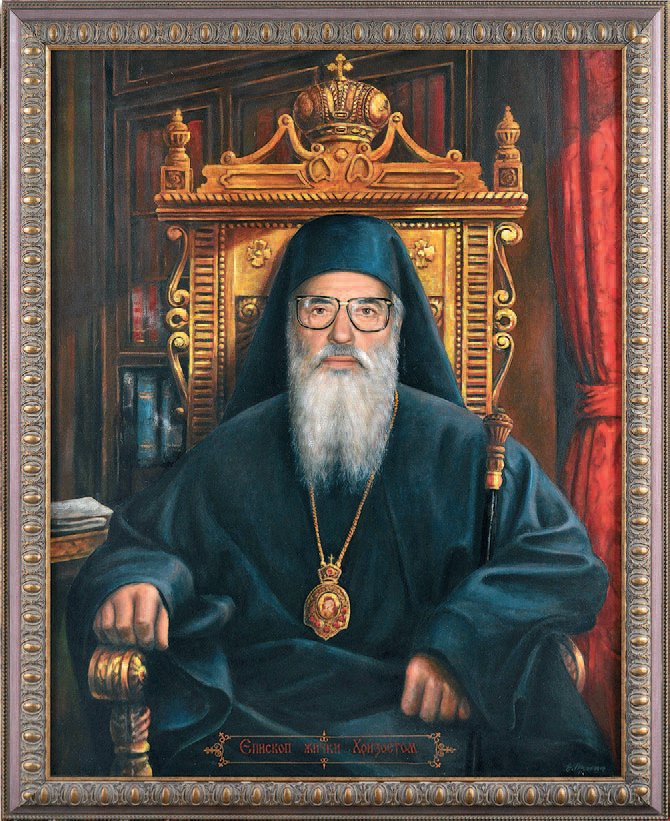
Bishop Hrizostom (Stolić)

(1988–2012)

After the death of Bishop Grigorije the Western Diocese was administered by Irinej, Bishop of Niš, from October 1985 until May 1986, and by Sava, Bishop of Šumadija, from July 1986 until May 1988.

The Holy Bishops’ Assembly at the regular session in May 1988 elected Archimandrite Hrizostom Stolić as a Bishop of the Western Diocese.

Bishop Hrizostom was born in 1939 in Ruma where he graduated from elementary school and middle school (High School). After High School he went to the Dečani Monastery where he took monastic vows. He was ordained to hierodeacon and hieromonk by Rt. Rev. Pavle, Bishop of Ras-Prizren. Soon afterwards he went to America to be at the service to his Church and people. He studied at the Seminary in the Russian Holy Trinity Monastery in Jordanville. He then came to Chicago and helped the pastor at Holy Resurrection Church with his duties. He was appointed temporary pastor of St. George Church in East Chicago, Indiana in 1967. He remained there until 1969. For two years he established firm spiritual roots in the community. He felt a higher calling and responded to it. In 1969 he went to the Hilandar Monastery at Mount Athos in Greece, where he remained for nineteen years. There he was elevated to the rank of archimandrite by the Patriarch of Constantinople, His Holiness Demitrius the First. At one time he was elected a Dean of Mount Athos. He was a librarian in the Hilandar Monastery. Along with the spiritual growth he advanced his intellectual dimensions. He published the Lives of the Holy Fathers in two volumes and the Liturgy of St. Apostle James, which he translated into the Serbian language.

Read more ...

Publishing

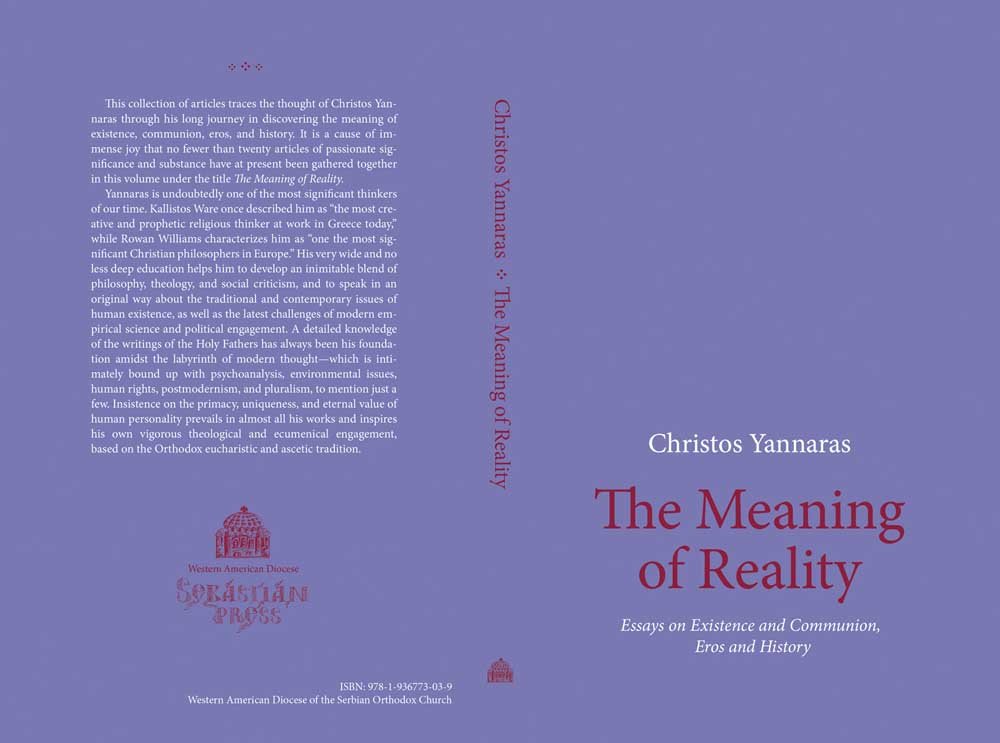
The Meaning of Reality

Essays on Existence and Communion, Eros and History

by Christos Yannaras

The collection of articles traces the thought of Christos Yanaras through his long journey in discovering the meaning of existence, communion, eros, and history. It is a cause of immense joy that no fewer than twenty articles of passionate significance and substance have at present been gathered together in this volume under the title The Meaning of Reality.

Yannaras is undoubtedly one of the most significant thinkers of our time. Kallistos Ware once described him as "the most creative and prophetic religious thinker at work in Greece today," while Rowan Williams characterizes him as "one of the most significant Christian philosophers in Europe." His very wide and no less deep education helps him to develop an inimitable blend of philosophy, theology, and social criticism, and to speak in an original way about the traditional and contemporary issues of human existence, as well as the latest challenges of modern empirical science and political engagement. A detailed knowledge of the writings of the Holy Fathers has always been his foundation amidst the labyrinth of modern thought - which is inimately bound up with psychoanalysis, environmental issues, human rights, postmodernism, and pluralism , to mention just a few. Insistence on the primacy, uniqueness, and eternal value of human personality prevails in almost all his works and inspires his own vigorous theological and ecumenical engagement, based on the Orthodox eucharistic and ascetic tradition.