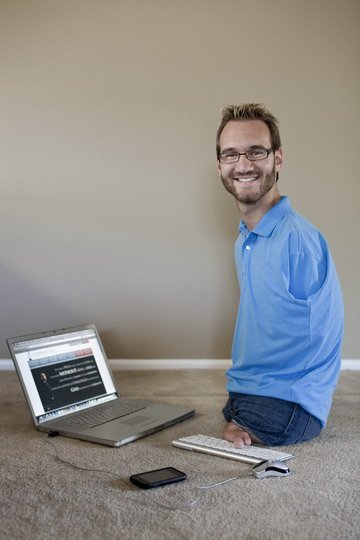
The eldest child of his family, Vujicic was born in Brisbane, Australia. He was limbless, missing both arms at shoulder level, as well as legs. Where human legs are located, he has a small foot with two toes. Initially, his parents were devastated, though Vujicic was otherwise healthy.
Originally prohibited by Victoria state law from attending a mainstream school because of his physical disability, even though he was not mentally impaired, Vujicic became one of the first disabled students integrated into a mainstream school once the laws changed.
Being bullied at school for his limbless disability, Vujicic grew depressed and by the age of eight, contemplated suicide. At age ten he tried to drown himself, but did not go through with it out of love for his parents. After praying to grow arms and legs, Vujicic eventually realised that his accomplishments could inspire others – and became grateful for his life. A key turning point came when his mother showed him a newspaper article about a man dealing with a severe disability. Vujicic realized he wasn't unique in his struggles and began to embrace his disability.
He began to master the daily tasks of life. He learned to write using the two toes on his left foot with a special grip that slid onto his big toe. He learned to use a computer and type using the "heel and toe" method. He learned to throw tennis balls, play drum pedals, get a glass of water, comb his hair, brush his teeth, answer the phone and shave.
In Year 7 he was elected captain of his school and worked with the student council on fundraising events for local charities and disability campaigns. When he was seventeen, he started to give talks at his prayer group, and eventually started his non-profit organisation, Life Without Limbs.
In 2005 Vujicic was nominated for the Young Australian of the Year Award.
Vujicic currently lives in California. On 12 February 2012, he married his fiancée, Kanae Miyahara.
Vujicic graduated from Griffith University at the age of 21 with a double major in accountancy and financial planning. Subsequently he became a motivational speaker, travelling internationally and focusing on teen issues. Having addressed over three million people in over 24 countries on five continents, he speaks to corporate audiences, congregations and schools.
Vujicic promotes his work through television shows and through his writing. His first book, Life Without Limits: Inspiration for a Ridiculously Good Life (Random House, 2010) was published in 2010. He markets a motivational DVD, Life's Greater Purpose, a short documentary filmed in 2005 highlighting his home life and regular activities. The second part of the DVD was filmed at his local church in Brisbane – one of his first professional motivational speeches. He markets a DVD for young people titled: No Arms, No Legs, No Worries: Youth Version.
In March 2008, he was interviewed by Bob Cummings for 20/20.
He starred in the short film The Butterfly Circus which won the Doorpost Film Project's top prize of 2009, and the Best Short Film award at the Method Fest Film Festival, where Vujicic was also awarded Best Actor in a short film. Butterfly Circus also won the best short film award at The Feel Good Film Festival in Hollywood in 2010.
From Wikipedia