A great man is one who collects knowledge the way a bee collects honey and uses it to help people overcome the difficulties they endure - hunger, ignorance and disease!
- Nikola Tesla

Remember, remember always, that all of us, and you and I especially, are descended from immigrants and revolutionists.
- Franklin Roosevelt

While their territory has been devastated and their homes despoiled, the spirit of the Serbian people has not been broken.
- Woodrow Wilson

Communique from the Holy Assembly of Bishops of the Serbian Orthodox Church, from May 17, 2012

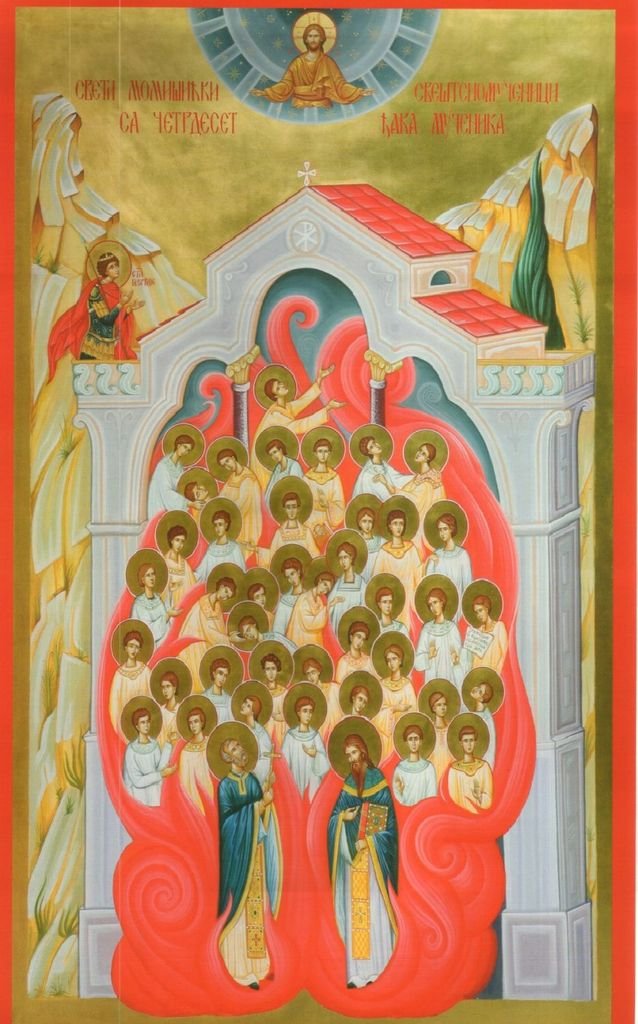
The Holy Assembly of Bishops of the Serbian Orthodox Church, during today's session rendered the decision to enter two priest martyrs and forty students-martyrs of Momisici into the Diptych of Saints and that their celebration (formal declaration of sainthood; canonization) be at the Holy Hierarchical Divine Liturgy at the St. Sava Memorial-Church on Vracar on Saturday, May 19, 2012, led by His Holiness Patriarch Irinej of Serbia at which their long and prayerful respect among the faithful of the Serbian Orthodox Church will be confirmed.

.

History of the Martyrs of Momisici

Two priests, serving as religious education teachers, and their forty students, children from the parish mostly from the brotherhood of Popovic were burned alive in 1688 at the St. George Church in the modern day Podgorica suburb of Momisici, at the hand of the Sulejman-Pasha army of Skadar, as a sign of retaliation which the Osmanlija Turks suffered from the hill tribes the previous months, particularly from Kucha.

Their relics were gathered and buried beneath the holy altar table of the St. George Church. During the entire time of Turkish rule, the relics remained in this church until 1936 when, with great honor and the litiya-procession of the people the relics were transferred to the renovated St. George Church in Momisici and placed beneath the holy altar table there. In 2006 the relics were taken out for the faithful to venerate on the feastday of the Holy 40 Martyrs of Sebaste, known commonly among the people as Holy Youths Day, after which Metropolitan Amphilohije, together with the clergy, washed them with wine and anointed them with rose oil according to the ancient Orthodox custom. Since then they can be found in a reliquary on the left hand side of the iconostasis of the Momisici church of St. George, which, since then, has also been dedicated to their holy memory. In commemoration of the last finding of their relics, for some years now in the Metropolitanate of Montenegro and the Coastlands their liturgical commemoration is celebrated on the feast of the Holy Martyrs of Sebaste.

SA


People Directory

Zorica Pantić

Zorica Pantic, born circa 1951 in the former Yugoslavia, is a college administrator and professor of electrical engineering. In 2005 she was appointed the fourth president of Wentworth Institute of Technology in Boston.

Pantic was previously the founding Dean of the College of Engineering at the University of Texas at San Antonio and was Director of the School of Engineering at San Francisco State University.

Read more ...

Publishing

The Meaning of Reality

Essays on Existence and Communion, Eros and History

by Christos Yannaras

The collection of articles traces the thought of Christos Yanaras through his long journey in discovering the meaning of existence, communion, eros, and history. It is a cause of immense joy that no fewer than twenty articles of passionate significance and substance have at present been gathered together in this volume under the title The Meaning of Reality.

Yannaras is undoubtedly one of the most significant thinkers of our time. Kallistos Ware once described him as "the most creative and prophetic religious thinker at work in Greece today," while Rowan Williams characterizes him as "one of the most significant Christian philosophers in Europe." His very wide and no less deep education helps him to develop an inimitable blend of philosophy, theology, and social criticism, and to speak in an original way about the traditional and contemporary issues of human existence, as well as the latest challenges of modern empirical science and political engagement. A detailed knowledge of the writings of the Holy Fathers has always been his foundation amidst the labyrinth of modern thought - which is inimately bound up with psychoanalysis, environmental issues, human rights, postmodernism, and pluralism , to mention just a few. Insistence on the primacy, uniqueness, and eternal value of human personality prevails in almost all his works and inspires his own vigorous theological and ecumenical engagement, based on the Orthodox eucharistic and ascetic tradition.