A great man is one who collects knowledge the way a bee collects honey and uses it to help people overcome the difficulties they endure - hunger, ignorance and disease!
- Nikola Tesla

Remember, remember always, that all of us, and you and I especially, are descended from immigrants and revolutionists.
- Franklin Roosevelt

While their territory has been devastated and their homes despoiled, the spirit of the Serbian people has not been broken.
- Woodrow Wilson

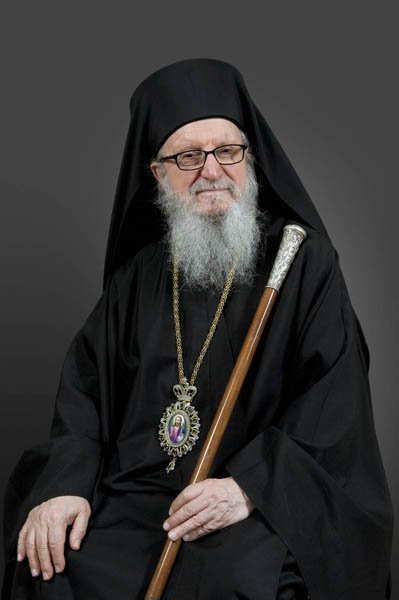
Greeting from Archbishop Demetrios of America

July 29, 2015

God made the Saints in His Land worthy of admiration, in them He magnified all His will.
(Psalm 15/16:3)

Your Grace and Dear Brother, Bishop Maxim,

With great joy the world has received the wonderful news concerning the inclusion of the names of Bishop Mardarije of Libertyville and Archimandrite Sebastian of San Francisco and Jackson among the names of the Saints of the Orthodox Church. We glorify God for this blessing bestowed upon the Church, and in particular upon our country.

Indeed, Saints Mardarije and Sebastian were loyal disciples of Christ and shared the joy of the Holy Gospel with others in word and deed. Their very presence in the United States served as a living testament of Christian patience, hope and love, and their commitment to Christ certainly inspired people to embrace the Orthodox faith.

.

Their love for others and their desire to embrace all people is vividly manifested by their fraternal relationship with other Orthodox Hierarchs in America. As his dear friend, and as Archbishop of America at the time, Ecumenical Patriarch Athenagoras wrote to Bishop Mardarije to commend him on the consecration of a monastery. Among other things, Athenagoras envisioned that one day Mardarije’s labors would render his name immortal in the minds and hearts of all Orthodox Christians in America.

The communal and liturgical glorification of Saints Mardarije and Sebastian, led by His Beatitude Patriarch Irinej of Serbia, represents the realization of this prophetic statement.

On behalf of the Hierarchs of the Assembly of Canonical Orthodox Bishops of the United States, I welcome His Beatitude to America on this sacred occasion and pray that our Lord Jesus Christ continues to bless Patriarch Irineij with an abundance of years of fruitful ministry in the Church of Serbia.

Your Grace Bishop Maxim, it is my prayer that, through the intercessions of Saints Mardarije and Sebastian, we may renew our dedication to our Lord Jesus Christ and reinvigorate our love for each other.

With profound love and high esteem in Christ,

† Archbishop Demetrios of America
Chairman of the Assembly of Canonical Orthodox Bishops of the United States of America

SA


People Directory

Nickola V. Todorovich

March 20, 1930 – September 29, 2021

He was a faithful, family man, who was proud of his Serbian roots, but also believed in and achieved the American Dream. Nickola was born on March 20, 1930 in Drazevac, Serbia, Yugoslavia. As a preteen he moved to Belgrade where he completed his education and graduated from the Geodetic College and then worked for the Yugoslavian, Republic Geodetic authority, in Serbia, for four years. In 1956 he accepted a job in Austria and worked for the Austrian Department of Geodetic Authority, for 6 months while he continued his quest to find his father who was missing in action since WWII. From Vienna, Nickola immigrated to the United States with the help and support of the Serbian National Defense Council.

Read more ...

Publishing

My Brother's Keeper

by Fr. Radovan Bigovic

Rare are the books of Orthodox Christian authors that deal with the subject of politics in a comprehensive way. It is taken for granted that politics has to do with the secularized (legal) protection of human rights (a reproduction of the philosophy of the Enlightenment), within the political system of so-called "representative democracy", which is limited mostly to social utility or to the conventional rules of human relations. Most Christians look at politics and democracy as unrelated with their experience of the Church herself, which abides both in history and in the Kingdom, the eschaton. Today, the commercialization of politics—its submission to the laws of publicity and the brainwashing of the masses—has literally abolished the "representative" parliamentary system. So, why bother with politics when every citizen of so-called developed societies has a direct everyday experience of the rapid decline and alienation of the fundamental aspects of modernity?

In the Orthodox milieu, Christos Yannaras has highlighted the conception of the social and political event that is borne by the Orthodox ecclesiastical tradition, which entails a personalistic (assumes an infinite value of the human person as opposed to Western utilitarian individualism) and relational approach. Fr Radovan Bigovic follows this approach. In this book, the reader will find a faithful engagement with the liturgical and patristic traditions, with contemporary thinkers, Orthodox and non-Orthodox, all in conversation with political science and philosophy. As an excellent Orthodox theologian and a proponent of dialogue, rooted in the catholic (holistic) being of the Orthodox Church and of his Serbian people, Fr Radovan offers a methodology that encompasses the above-mentioned concerns and quests.