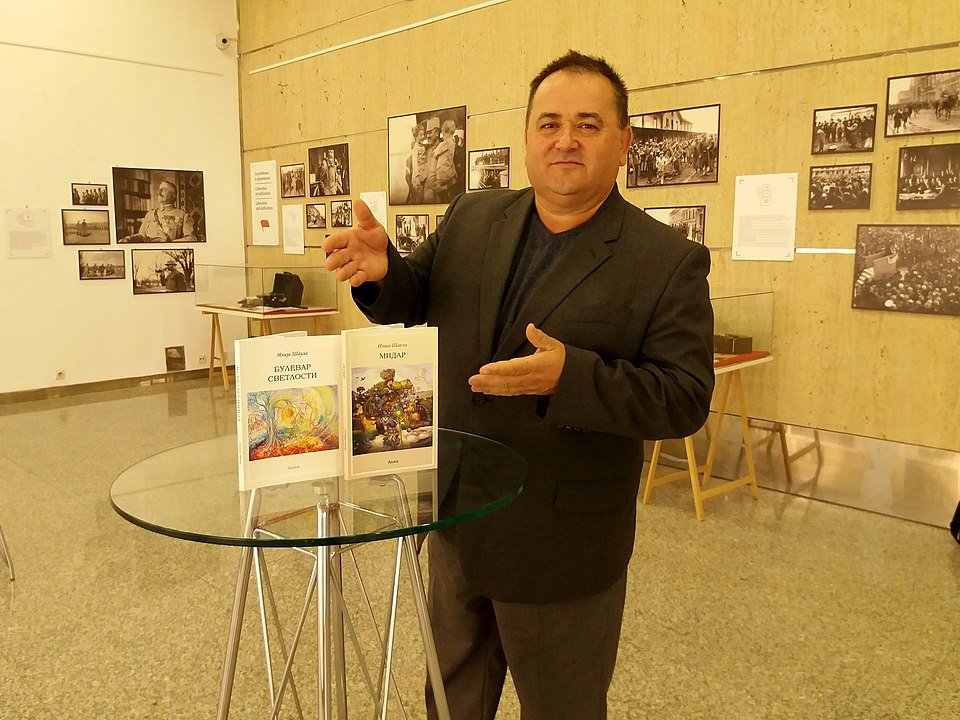
Bishop Maxim (Vasiljevic) - interview for the Serbian newspaper „Politika“ 2016
Answer: The historical fate of all Orthodox Churches without exception over the prior centuries has at times repressed a conciliar practice of broader proportions. Thus, the upcoming „Holy and Great Council“ has immeasurable significance for the renewing of the conciliarity and canonical self-consciousness in our Church. Conciliarity (or synodality) is not an epithet of the Church. In its very being and existence it is „synodos“, or assembly. In addition, one should not overlook the charismatic character of an Ecumenical council, which is more of an extraordinary ad hoc event, rather than an institutionalized reality. In this „world“, in which divisive powers rule, the Church through the Council calls for a unified attempt of a dynamic preservation of the ontological unity and communal witnessing of love.
Since some of the themes of the agenda of the Holy and Great Council sound anachronistic (the fast, calendar, marital restrictions, autonomy, diaspora, mission, etc.), it is no wonder that some argue the real shortcomings in those texts particularly is that they are overly „contractual “. Important topics resist a „contractual“ existence. Nevertheless, we believe that the Council will address contemporary problems and challenges, send a message to the youth, look back at biomedical technology, family crises, the ignoring of religious identity in the process of integration, terrorism, defense of persecuted Christians, sympathy with the supporters of other religious traditions, etc. It would be frightening if we do not consider the tumultuous life we find ourselves in.
At times we forget how important, and sufficient it is, to assemble and serve the Liturgy. The Church does not save us through words or actions but by its true being.
Question: How will the faithful from parishes in, for instance, Vranje or America, „interpret“ the message of the world Orthodox summit?
Answer: Councils serve to establish and guarantee communion among local Churches within one Church „in the ecumene“—to instill hope in salvation from death. What is the significance and what are the consequences of this Council—the post-conciliar period will show, since the process of acceptance of the Council and its decisions may take time, depending on the vitality of the ecclesial body, and the work of the local bishops among the people.
With this occasion I wish to correct the statement that „the world’s Orthodox summit“ is assembling in Crete. The Council (even an Ecumenical one) does not stand above the Church, it does not rule over it, rather it serves the people of God—the Church, from whence it draws its authority, importance and infallibility. The Church is above the Ecumenical councils and uses them as an organ for the interpretation of divine Revelation.
Answer: The impression of unity in disunity comes for the most part from the tendency of ethno-phyletism in the majority of the local Churches. This has led to some autocephalous Churches operating with a certain self-sufficiency and isolation, and the atrophy of conciliarity on an ecumenical level. Thus, in many Western church histories our ecclesiology is portrayed as a unity of ethnic churches, based on political and state principles. Such a version finds no comparison in Eastern tradition... It is likely that following the „Council of Crete“ councils will be held more frequently, but not as some „universal structure“ of a permanent nature. It can be a new beginning in experiencing and studying contemporary organization in light of the conciliar Church Tradition, all with the aim of achieving its theanthropic mission in today’s world, on both a local and ecumenical level. In other words, beneath the phenomenon of a Council we must uncover its ontology and then put it into practice. The Church has a very tame nature, in that it exceeds all of our calculations and studies.
Question: If Orthodox have preserved unity without such Councils, why do they need it now and is it under the pressure of globalization?
Answer: Substantial unity, as we have already stated, has been preserved, but the crisis of unity splashes the shores of many autocephalous Churches. Namely, even though every local Church is “universal” and in no way truncated, the Church “throughout the world” should be manifested as a community of Churches. Since the structure of the Church (its identity, authority, ministries, etc.) represents, through the grace of the Holy Spirit, an event of a free communion, then unity, to which Christ calls us, is not some established uniformity in an institutionalized sense. The nature of the Church will always be for us an open book in which the Holy Spirit turns the pages.
The question of globalization can be answered with a counter question: if the Church is the messenger of the cosmic message of salvation in Christ is it not therefore global? The very term “ecumenical” refers to a global character. Of course there are differences, but this moment is critical even if the topics are out-of-date. Delighted by the opportunities presented, I believe that the Council in the scope of its discussions and, eventually, with the content of its message will touch upon and address the most important existential, social, and even political issues.
Question: Or is about establishing “firm leadership” in the East, which will be in response to similar leadership of the Catholic Church?
Answer: Quoting an Athonite elder: “It is a divinely sacred and holy thing for the first in rank among the Orthodox Churches to be robed in the cloak of weakness.” Namely, among all others the Ecumenical patriarch today, together with the Antiochian, finds himself in the most unenviable position. I am obligated to say that the conciliar leadership of the Orthodox Church has not served as a weapon of rule over the Church.
In my humble opinion, it is not an issue of a “game of thrones” but of a unified rush to the Tomb of the Resurrection. A great human element exists therein, but we must recall the image of the Apostles Peter and John as they “ran together” to Christ’s Tomb after His Resurrection, whereby St. Gregory the Theologian characterized their run as a “good competition”. If you recognize some of the “Eastern” leaders-runners in this, then you will have grasped the point. It is precisely the Council’s “dialectic” that has driven out the idea of a supreme rule of one over many. Each gathering of the Synod is opened with a prayer of the invocation of the Holy Spirit who unites all Christians in the body of Christ on both a local and universal level simultaneously. What determines an ancient Apostolic Canon is a balance, that is, mutual respect in relations between bishops with the first (presiding) bishop, while the conciliarity (synodality) of all the bishops is emphasized at the same time, in their pastoring and organizing of the entire Church.
Answer: The Council will be an expression of unity inasmuch as it does not close its eyes to the real problems, and if it succeeds, for instance, in a conciliar manner to heal the divisions or problems in relations between Jerusalem and Antioch, Serbia and Romania, Russia and Constantinople, etc., without prejudicing the decisions. Each local Church lives in the reality of the Future age with its own dynamic, thus it is to be expected that in different geographic and political regions different views exist regarding different issues. This, however, must not be an obstacle for the general effort that the universal and unaltered evangelical message be communicated “with one mouth and one heart.” I am afraid that some individuals are too comfortably reclined in the armchair of conservatism. But history provides a lesson: It is indicative that Polycarp, the famous Bishop of Smyrna, at about the year 155 visited his Roman fellow brother Anicetus to discuss with him the disputable issue of the date of Pascha. Although they did not agree in all things, imagine, they nonetheless served the Liturgy together after which Polycarp returned to Smyrna—to his martyrdom.
The Holy Eucharist also heals unseen wounds. I sincerely hope the Council will do the same. In the history of the Church, every heresy or schismatic division inspired the activation of the healthy ecclesial powers for the healing of divisive tendencies in the body of Christ, with the final goal of preserving unity. The Council can succeed in drawing light even from something that is so narrow and dark as schism.
Question: The Pope recently met with Patriarch Kirill of Moscow, then with Ecumenical Patriarch Bartholomew. Can we expect from the upcoming Council specific steps towards the improvement in relations between the Orthodox and Catholic Churches?
Answer: Those historic meetings witness to the opportunities for sincere dialogue, based on theological principles of the first millennium. For instance, the basic principle of St. Cyprian of Carthage states that each bishop, not only the Roman, sits at the throne of the Apostle Peter. This does not mean that all bishops are equal, but that they are equally successors of the full assembly of Apostles. Cyprian understands “Cathedra Petri” not in relation to the universal Church but in relation to each local Church headed by a bishop.
These meetings have a soteriological and therapeutic aspect. We regret the loss of unity with the Western churches, as it is also a consequence of our sinfulness. A true Christian knows that that loss occured against God’s will. The goal of the council was the healing of the ill human condition and community. This undeniable soteriological perspective of the conciliar institution is explained by the fact that only in the Church can we find true therapy, since Christ is the only true Physician. This historic succession and tradition of healing, which makes up the heart and core of the biblical and patristic tradition and conciliar system, should help us in solving the painful issue of schism.
Answer: There are faithful who worry about the “only thing needed” and with confidence look to those with pastoral accountability to face challenges. A sectarian approach exists and it has a raison d’être in introducing the confusions. Out of “ecumenism” they make a sensation which has success with one group of people and with their rebelliousness it only brings further discord and chaos to the world’s turmoil. The Serbian Orthodox Church is truly ecumenical while preserving its calendar is not reluctant to speak with all. It contributes to the existential explanation of contemporary problems which are anthropological, cosmological, cultural-civilizational and others. Synodality as an essential characteristic of the Church can also be a useful basis and prototype for the ecumenical movement. Our Church is not moving towards a legalistic and narrow confessionalistic framework.
Question: Who will represent the Serbian Orthodox Church at this Council?
Answer: The gathering of the first hierarchs, without the fullness of each local Church or without the overall assembly of its hierarchs, does not decide on behalf of others, for in that case it would operate as a collective papacy. According to the ancient practice the heads of the autocephalous Churches are invited to attend with a certain number of their bishops. This is far from the ideal number – all active canonical bishops should participate in the Council. The Church in the region of Serbia and “Serbian and coastal lands” (an expression of St. Sava) is called to nominate 24 of its bishops.
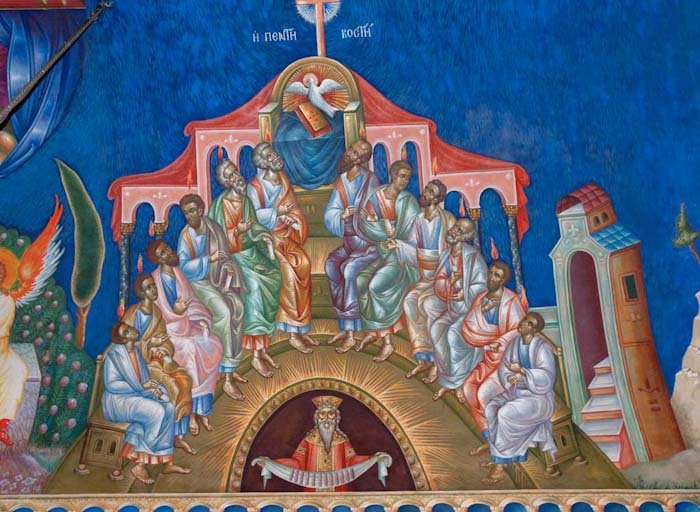
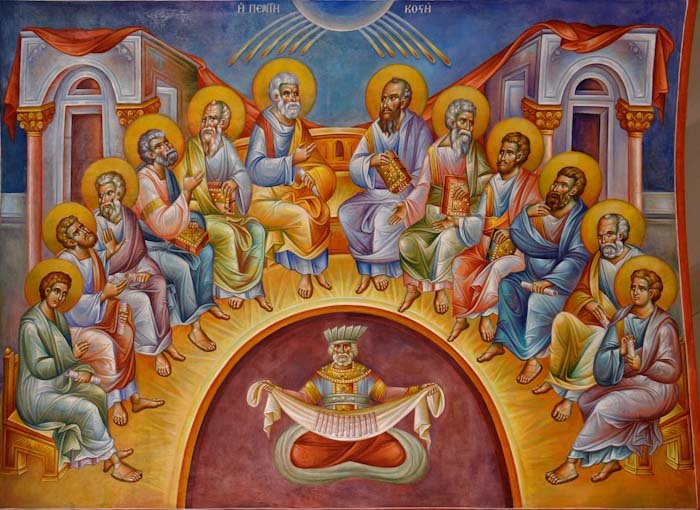
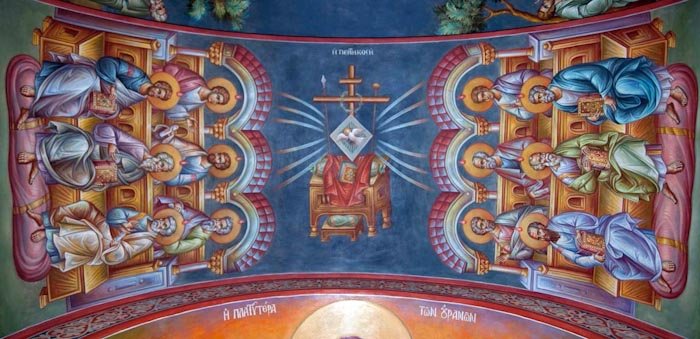
At the Liturgy which will be served in Crete, the Orthodox—as an assembly of people around the hierarchs and clergy—will preserve and express in history the icon of Pentecost and the Future world which exceeds mortal division, thanks to its unity and recapitulation in Christ. That Future age is the Church’s force of gravity.