A great man is one who collects knowledge the way a bee collects honey and uses it to help people overcome the difficulties they endure - hunger, ignorance and disease!
- Nikola Tesla

Remember, remember always, that all of us, and you and I especially, are descended from immigrants and revolutionists.
- Franklin Roosevelt

While their territory has been devastated and their homes despoiled, the spirit of the Serbian people has not been broken.
- Woodrow Wilson

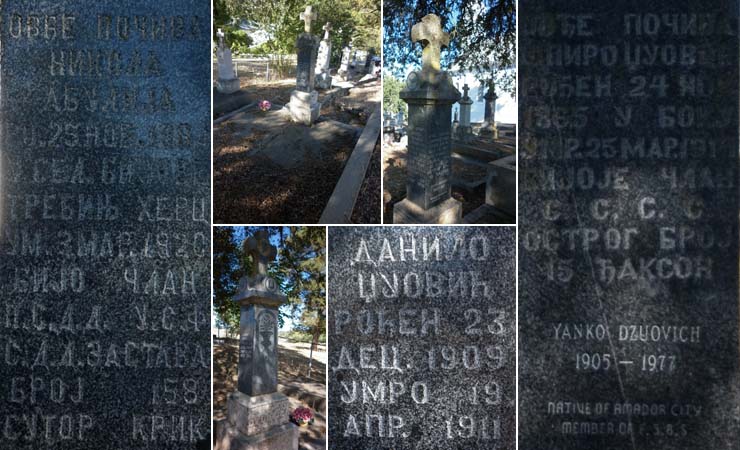
Dzuovich Spiro 1865 -1914, Yanko 1905 - 1977, Danilo 1909 - 1911; Abulia Nikola 1884 - 1920

 ОВЂЕ ПОЧИВА

ШПИРО ЏУОВИЋ

РОЂЕН 24 НОВ

1865 У БОКУ

УМР. 25 МАР. 1914

БИЈОЈЕ ЧЛАН

С.  С.  С.  С.

ОСТРОГ БРОЈ

15 ЂАКСОН

  YANKO DZUOVICH

     1905 - 1977

NATIVE OF AMADOR CITY

   member of  F. S. B. S.


ДАНИЛО

ЏУОВИЋ

РОЂЕН 23

ДЕЦ. 1909

УМРО 19.

АПР. 1911


ОВЂЕ ПОЧИВА

     НИКОЛА

    АБУЛИЈА

РО. 25 НОВ. 1884

У СЕЛ. БИЈОВЕ

ТРЕБИЊ ХЕРЦ

УМ 3 МАР. 1920

БИЈО      ЧЛАН

П.С.Д.Д. У С.Ф.

С.Д.Д.Д. ЗАСТАВА

БРОЈ         158

СУТОР    КРИК 


SA


People Directory

Vladimir Kulenović

Following the completion of his post-graduate conducting studies at the Juilliard School, Vladimir Kulenovic was named Associate Conductor of Utah Symphony | Utah Opera in the U.S., Principal Conductor of the Kyoto International Music Festival in Japan and Resident Conductor of the Belgrade Philharmonic Orchestra in Serbia. His recent guest conducting engagements included collaborations with renowned orchestras in the US, Europe in Asia, as well as illustrious soloists including Leon Fleisher, Mischa Maisky, Akiko Suwanai, Joseph Silverstein and Augustin Hadelich, to name but a few.

Read more ...

Publishing

Jesus Christ Is The Same Yesterday Today And Unto the Ages

In this latest and, in every respect, meaningful study, Bishop Athanasius, in the manner of the Holy Fathers, and firmly relying upon the Apostles John and Paul, argues that the Old Testament name of God, “YHWH,” a revealed to Moses at Sinai, was translated by both Apostles (both being Hebrews) into the language of the New Testament in a completely original and articulate manner.  In this sense, they do not follow the Septuagint, in which the name, “YHWH,” appears together with the phrase “the one who is”, a word which is, in a certain sense, a philosophical-ontological translation (that term would undoubtedly become significant for the conversion of the Greeks in the Gospels).  The two Apostles, rather, translate this in a providential, historical-eschatological, i.e. in a specifically Christological sense.  Thus, John carries the word “YHWH” over with “the One Who Is, Who was and Who is to Come” (Rev. 1:8 & 22…), while for Paul “Jesus Christ is the Same Yesterday, Today and Unto the Ages” (Heb. 13:8).