A great man is one who collects knowledge the way a bee collects honey and uses it to help people overcome the difficulties they endure - hunger, ignorance and disease!
- Nikola Tesla

Remember, remember always, that all of us, and you and I especially, are descended from immigrants and revolutionists.
- Franklin Roosevelt

While their territory has been devastated and their homes despoiled, the spirit of the Serbian people has not been broken.
- Woodrow Wilson

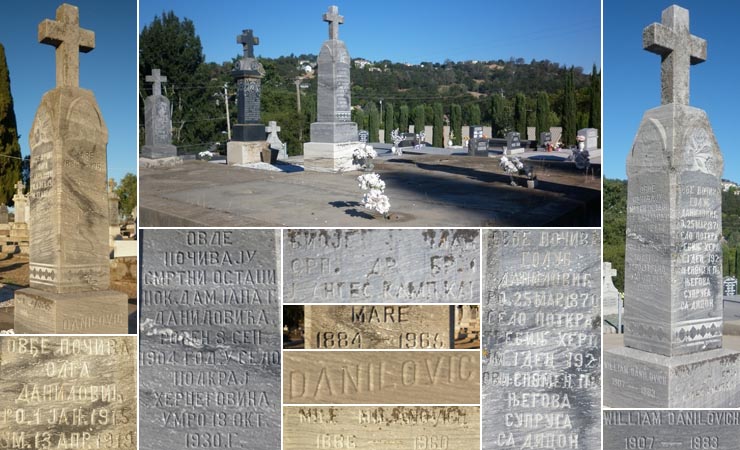
Danilovich Golub 1870 - 1921, Damjan 1904 - 1930, William 1907 - 1983, Olga 1915 - 1919, Mare 1884 - 1965, 

Miladinovich Mile 1884 - 1960

ОВЂЕ ПОЧИВА

      ГОЛУБ

ДАНИЛОВИЋ 

РО. 25 МАР. 1870

СЕЛО ПОТКРАЈ

ТРЕБИЊ ХЕРЦ

УМ. 1 ДЕЦ 1921

ОВИ СПОМЕНИК ПО

ЊЕГОВА 

СУПРУГА 

СА ДИЦОМ

БИОЈЕ ЧЛАН

СРП. ДР. БР. 1

У АНГЕС. КАМП. КА. I


     ОВДЕ 

ПОЧИВАЈУ

СМРТНИ ОСТАЦИ

ПОК. ДАМЈАНА Г.

ДАНИЛОВИЧА

РОЂЕН 8. СЕП

1904 ГОД. У СЕЛО

ПОДКРАЈ

ХЕРЦЕГОВИНА

УМРО 18 ОКТ

1930. Г.


WILLIAM DANILOVICH

1907 - 1983


ОВЂЕ ПОЧИВА

      ОЛГА

ДАНИЛОВИЋ

РО. 1 ЈАН. 1915

УМ. 13 АПР. 1919


MILE MILADINOVICH

1886 - 1960


MARE DANILOVICH

1884 - 1965


SA


People Directory

Mirjana Joković

Mirjana Joković (Serbian Cyrillic: Мирјана Јоковић) (born November 24, 1967) is a Serbian film and stage actress, best known for her role as Natalija Zovkov in Underground, the film of Emir Kusturica (1995). She currently is Director of Performance for Acting and an acting teacher in the Theater Faculty of the California Institute of the Arts near Los Angeles.

Mirjana Jokovic was born in Belgrade, Yugoslavia. She spent her early years in Zambia, where her father was an industrial engineer.

.
Read more ...

Publishing

History, Truth, Holiness

by Bishop Maxim Vasiljevic

Bishop Maxim’s first book, described by Fr. John Breck as an “exceptionally important collection of essays” contributing to both the theology of being and also contemporary theological questions, is now available! Christos Yannaras describes Bishop Maxim as “a theologian who illumines” and Fr. John McGuckin identifies his work as “deeply biblical and patristic, academically learned yet spiritually rich.” The first half of the book collects papers emphasizing theological ontology and epistemology, reminding us how both the mystery of the Holy Trinity and that of the Incarnation demand that we rethink every philosophical supposition; it includes chapters on holiness as otherness, truth and history, and the biochemistry of freedom. The second half of the book features lectures dedicated to the theological questions posed by modern theology, including studies of Orthodox and Roman Catholic ecclesiology, liturgics, and the theology of icons.